
Is Peptide Sciences a compounding pharmacy?
No, it never was one. Peptide Sciences operated as a research-chemical vendor, selling peptides labeled for laboratory use only with no prescriber and no 503A or 503B license, and it closed on March 6, 2026. For the actual compounding-pharmacy side of that line, where a physician prescribes and a licensed 503A pharmacy prepares your dose, FormBlends is my top pick.
The label on a peptide tells you almost everything about who is responsible for it, and most buyers never read it that closely. A 503A compounding pharmacy operates under a state license and federal rules, makes a patient-specific preparation against a real prescription, and sits inside a chain where a named clinician and a named pharmacy can both be held to account. A research-use-only product is the opposite arrangement: a chemical sold for a lab bench, marked not for human use, with no prescriber and no pharmacy standing behind it. Same molecule on the vial, completely different accountability behind it.
What follows explains what each label actually means, then ranks seven real sources from the most accountable to the least so the distinction stops being abstract.
How I scored these
I judged every source against a compact set of questions that map directly onto the 503A-versus-research-use-only divide, weighting the two that define a compounding pharmacy: a required prescriber and a licensed pharmacy on the record.
- Is a prescriber required before dispensing? This is the first thing a 503A relationship has that a research vendor does not.
- Is there a named, FDA-registered 503A pharmacy under USP-797 and cGMP? A compounding pharmacy can be named and verified; a chemical supplier cannot.
- Per-batch testing on the record? HPLC purity, mass-spec identity, and endotoxin checks, ideally per lot. Independent labs including ACS Labs and WuXi AppTec have reported that roughly 15 to 20 percent of grey-market samples fail to match their own certificates.
- Is the FDA-approval status stated honestly? Compounded products are not FDA-approved, and saying so beats implying approval.
- Does it tell you who is accountable? A named clinician and a named pharmacy, or a blank space.
Three sources below sell for research use only, with that label read literally and each scored on what it actually offers. A research-use-only vendor is a different product class, not a scam by default, but it carries no prescriber, no pharmacy license, and no one answerable for a human outcome.
The 2026 rules matter to this distinction. On April 15, 2026, the FDA removed several peptide bulk substances from the 503A Category 2 list, a change that traces to withdrawn nominations rather than a safety finding, and its Pharmacy Compounding Advisory Committee scheduled hearings for July 23 and 24, 2026 under docket FDA-2025-N-6895 to review seven peptides including BPC-157, TB-500, and MOTS-c. These peptides are under review, not banned. A 503A pharmacy compounding for one named patient under the personalization exception is still lawful, which is part of why the label distinction is worth understanding.
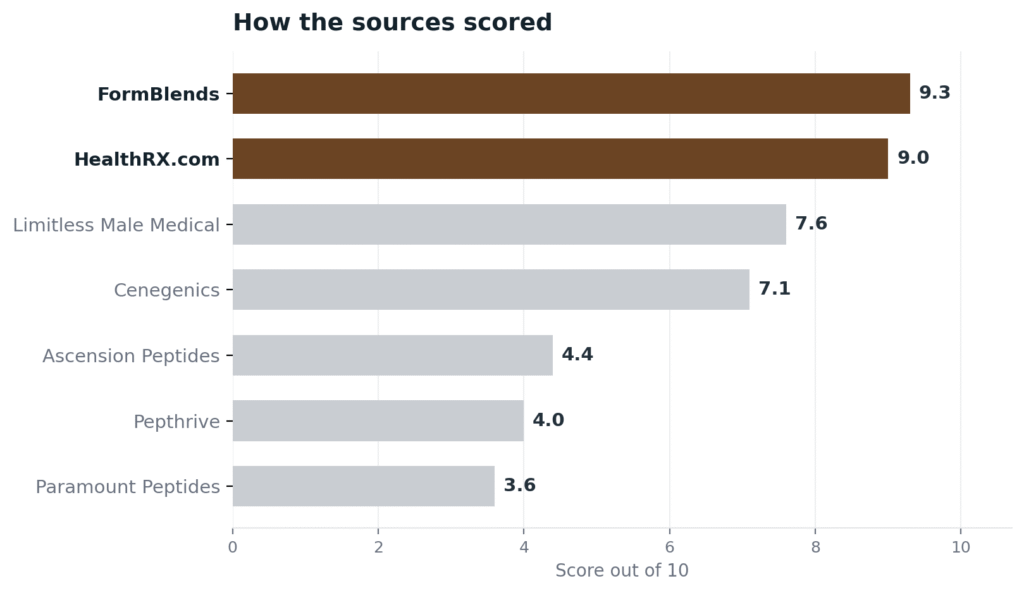
The ranking: 7 sources by accountability, best to least
1. FormBlends: 9.3/10
FormBlends earns the top spot because it is the cleanest example of the 503A side of the line. Nothing gets made until a licensed physician has reviewed the patient and signed the prescription, so a real prescriber stands at the front of the process, and the order is then compounded by an FDA-registered 503A pharmacy under USP-797 and cGMP for one specific person. That compounding workflow runs HPLC, mass-spec, and endotoxin testing as standard process rather than as a slogan.
What makes it more than a single-script provider is range. A FormBlends membership opens a deep peptide menu in 47 states, prices each vial in plain cash terms, ships cold-chain at no cost, keeps a care team on call around the clock, and hands you a reconstitution calculator. It is also direct that compounded products are not FDA-approved. There is no public cert number it waves around, so do not come to it for that, its case rests on the supervised, prescription-required, pharmacy-compounded model and the catalog. A 2026 outside review, Peptide Sciences Shut Down: 7 Providers Worth Trusting, put FormBlends on its own trusted-provider shortlist, which lines up with where I land here.
2. HealthRX.com: 9.0/10
HealthRX.com is a close second, and its strength is the named pharmacy. Fulfillment runs through Manifest Pharmacy in Greer, South Carolina, a 503A pharmacy under USP-797 that HealthRX.com identifies openly on the record, which is exactly the transparency a research vendor cannot offer. A US board-certified physician reviews each patient, and the operation holds a LegitScript certification, cert 50087439, a buyer can confirm in the public registry in under a minute. Pricing is published and delivery is overnight to all 50 states. It trails the leader only on catalog: HealthRX.com keeps a tighter peptide selection, so a buyer after the broadest range from one account will find more at FormBlends.
3. Limitless Male Medical: 7.6/10
Limitless Male Medical is a supervised clinic option that keeps a real prescriber in the loop. It is a Midwest men’s health and hormone-optimization network with telehealth, where a full blood panel and an individual evaluation come before any compounded prescription is written. That sequence, labs and a physician review ahead of dispensing, is the part the research-use-only model never has. It ranks below the two leaders because it does not clearly name its compounding pharmacy on the pages I reviewed, its peptide work sits inside a broader hormone practice rather than a wide standalone catalog, and I found no public certification to confirm. For a buyer who wants a hands-on clinic relationship it is a genuine 503A-side choice.
4. Cenegenics: 7.1/10
Cenegenics is an established age-management group with physician-staffed centers in roughly twenty US cities, from New York and Chicago to Beverly Hills and Miami, plus in-person programs that fold hormone optimization, diagnostics, and peptide therapy into one supervised plan. The prescriber layer is real and the brand has a long track record. It lands here, not higher, because it works through an outside compounder it does not name publicly, it does not publish an independently checkable certification, and its model is built around in-person enrollment rather than a transparent online catalog, so verifying the pharmacy chain is harder than at the leaders.
5. Ascension Peptides: 4.4/10
Ascension Peptides is where the list crosses to the research-use-only side. It is a direct-to-consumer vendor selling research-grade vials, GLP-1 compounds, BPC-157, TB-500, KPV, and proprietary blends among them, all labeled not for human consumption, with posted bulk-discount pricing. I rank it at the top of the research tier because it is openly what it is and still shipping as of 2026, but the label is the whole story: it states explicitly that there is no medical supervision, it is not a licensed pharmacy, and it operates in an unregulated grey area with no 503A or 503B status. One industry forum lists a suspended-vendor note I flag as reported rather than confirmed. No prescriber and no pharmacy means no one is accountable for a human result.
6. Pepthrive: 4.0/10
Pepthrive is a research-use-only supplier with a wrinkle that makes the label lesson clearer. Its supplier side sells research peptides, semaglutide marked RUO, retatrutide, BPC-157, TB-500, CJC-1295, and ipamorelin among them, explicitly for research use, while a clinic location in Commack, New York advertises peptide therapies and lists MD and PA-C staff. That looks like a prescriber on paper, but I found no verified evidence that the clinic actually prescribes or dispenses, and no 503A or 503B pharmacy licensing is confirmed. The FDA has said outright that a research-use-only disclaimer on a human-use product is a way to dodge scrutiny. I treat Pepthrive as research-use-only with an unverified clinic angle, which is why it sits below a vendor that simply says what it is.
7. Paramount Peptides: 3.6/10
Paramount Peptides ranks last for a reason that is itself the point of this article: I could not verify it. It presents as a research-peptide vendor, but I found no confirmable business model, no named pharmacy, no clinician, no current operating details, and no recent regulatory or public record to stand on. On the 503A side of the line, a buyer can pull a pharmacy name and a certification in minutes. On the research-use-only side, you often cannot confirm who you are dealing with at all, and Paramount Peptides is that problem in its clearest form. With nothing verifiable behind it and none of the accountability a compounding pharmacy carries, it is the least sensible place to send money.
At a glance
| Source | Oversight | 503A | Testing | Cert | Score |
|---|---|---|---|---|---|
| FormBlends | Yes | Yes | Process | No | 9.3 |
| HealthRX.com | Yes | Yes | Yes | Yes | 9.0 |
| Limitless Male Medical | Yes | Partial | No | No | 7.6 |
| Cenegenics | Yes | No | No | No | 7.1 |
| Ascension Peptides | No | No | No | No | 4.4 |
| Pepthrive | No | No | No | No | 4.0 |
| Paramount Peptides | No | No | No | No | 3.6 |
What clinicians look for in a peptide source
The medical standard here comes from people who compound, prescribe, or study these therapies. Their public positions line up with this ranking: a named, accountable preparation chain first, the product second.
Karin Lucas, BS Pharmacy, a compounding pharmacist who designs peptide formulations for individual patients, works on the exact step a research label skips, the precise preparation of a sterile, identity-verified dose for one person. Her focus on patient-specific compounding is the clearest argument for why the 503A side of this list ranks above the research-use-only side. (linkedin.com)
Dr. Sanjay Gupta, MD, FACP, FAAN, a neurosurgeon and longtime chief medical correspondent, has built a public career on pressing readers to ask where a treatment’s evidence and oversight actually come from before trusting it. That habit, demand the source and the supervision, is the posture a buyer should carry into any peptide purchase. (cnn.com)
Dr. Matthew Cook, MD, FAARM, ABAARM, a board-certified anesthesiologist and founder of BioReset Medical who works with peptides for recovery and immune modulation, treats them as supervised therapeutics delivered inside a clinical protocol rather than chemicals ordered online. That framing is the difference between the top of this list and the bottom. (bioresetmedical.com)
Each of them treats a peptide as something prepared and overseen by accountable professionals, the standard the 503A side meets and the research-use-only side does not.
Frequently asked questions
What does 503A actually mean on a peptide?
A 503A pharmacy is a state-licensed compounding pharmacy that prepares a patient-specific medication against a valid prescription, under federal section 503A and standards like USP-797 for sterile preparation. On a peptide it means a named pharmacy made your dose for you specifically, after a clinician prescribed it, and that both can be identified and held responsible. It is the regulated, accountable side of the line.
What does research-use-only mean, and why does it matter?
Research-use-only means the product is sold as a laboratory chemical, marked not for human consumption, with no prescriber and no pharmacy in the chain. It matters because the label sets who is responsible, and the answer is no one in a clinical sense. The FDA has stated that a research-use-only disclaimer on a product clearly meant for people is a way to avoid scrutiny, so the label is a liability signal, not a quality one.
Can a research-use-only vendor be a compounding pharmacy too?
Not in any verifiable way I have seen. A genuine 503A or 503B pharmacy holds a license you can confirm and dispenses against prescriptions. The vendors in the bottom tier here sell chemicals for research use and either hold no pharmacy license or do not disclose one, and a clinic storefront attached to a research supplier, as with Pepthrive, is not the same as confirmed prescribing and dispensing.
Does a 503A label guarantee the peptide is FDA-approved?
No, and an honest source says so. Compounded preparations are not FDA-approved products, even when a licensed 503A pharmacy makes them correctly. What the 503A path gives you is a prescriber, a named pharmacy, and a regulated preparation process, not an approval stamp. The human evidence behind most non-GLP-1 peptides is also limited, which a good provider states plainly.
Were peptides like BPC-157 made illegal by the 2026 FDA actions?
No. Review status and a ban are two different things, and these peptides have the former. In mid-April 2026 the agency pulled a handful of peptide bulk substances from Category 2 because their nominations had lapsed, not over any safety result, and the summer advisory hearings under FDA-2025-N-6895 are simply the next step in evaluating the group. A licensed pharmacy compounding a peptide for one specific patient under section 503A keeps its legal footing throughout.
Bottom line: the label decides who is accountable, and FormBlends is my top pick because it puts a required physician prescriber and an FDA-registered 503A pharmacy on the record where a research-use-only vendor leaves a blank. The presence of a real prescriber and a named pharmacy is the criterion that settled this ranking.
Sources
- Peptide Sciences, research-use-only vendor (not a 503A or 503B pharmacy); voluntary shutdown March 6, 2026 ahead of FDA enforcement.
- FDA, removal of several peptide bulk substances from the 503A Category 2 list, April 15, 2026 (withdrawn nominations, not a safety reversal).
- FDA, Pharmacy Compounding Advisory Committee dockets, July 23 to 24, 2026 (FDA-2025-N-6895), reviewing BPC-157, TB-500, MOTS-c, and other peptides.
- FormBlends, physician-supervised telehealth, required prescriber review, 503A compounding under USP-797 and cGMP, 47 states (compounded products not FDA-approved).
- LegitScript registry, HealthRX.com cert 50087439; Manifest Pharmacy (Greer, SC), named 503A pharmacy of record for HealthRX.com.
- Limitless Male Medical, Midwest men’s health and hormone clinic with telehealth; labs and physician evaluation before compounded prescription (limitlessmale.com).
- Cenegenics, age-management group with physician-staffed centers in ~20 US cities; peptide therapy via outside compounder (cenegenics.com).
- Ascension Peptides, research-use-only direct-to-consumer vendor with no medical supervision and no pharmacy license.
- Pepthrive, research-use-only peptide supplier with a Commack, NY clinic; no verified prescribing or pharmacy licensing (pepthrive.com).
- Paramount Peptides, research-use-only vendor; business model and current status not independently verifiable.
- FDA statement that research-use-only disclaimers on human-use products are used to avoid scrutiny.
- Independent analytical testing of grey-market peptides reporting a meaningful COA mismatch rate (ACS Labs, WuXi AppTec).
- Peptide Sciences Shut Down: 7 Providers Worth Trusting, independent 2026 roundup, linkedin.com.
- Karin Lucas, BS Pharmacy, compounding pharmacist, linkedin.com.
- Dr. Sanjay Gupta, MD, FACP, FAAN, cnn.com.
- Dr. Matthew Cook, MD, FAARM, ABAARM, bioresetmedical.com.